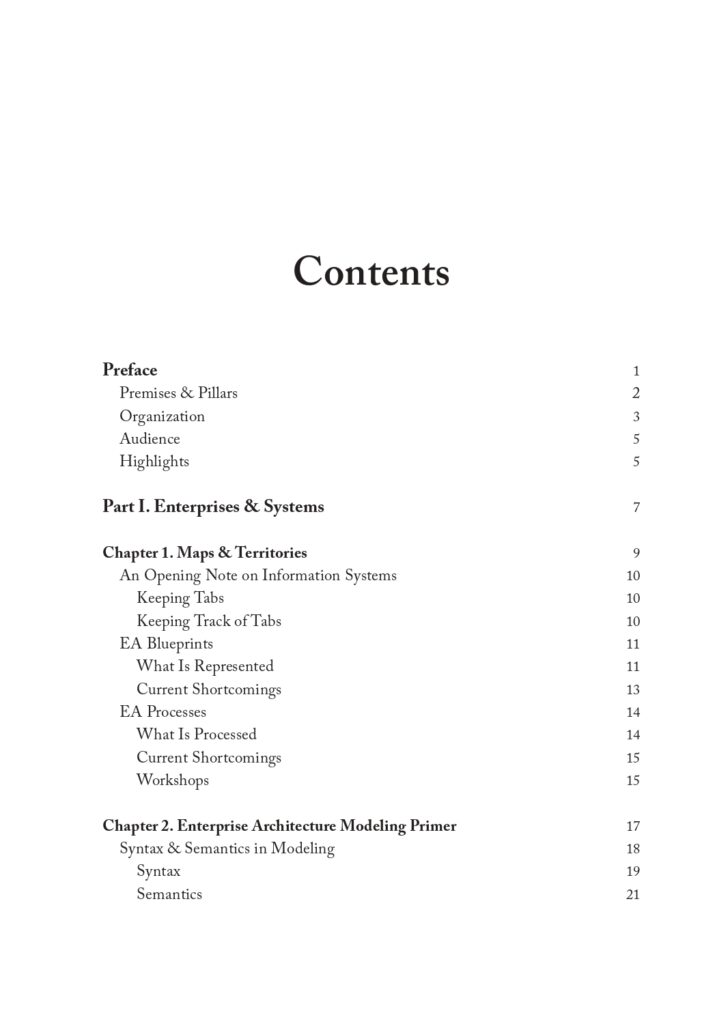
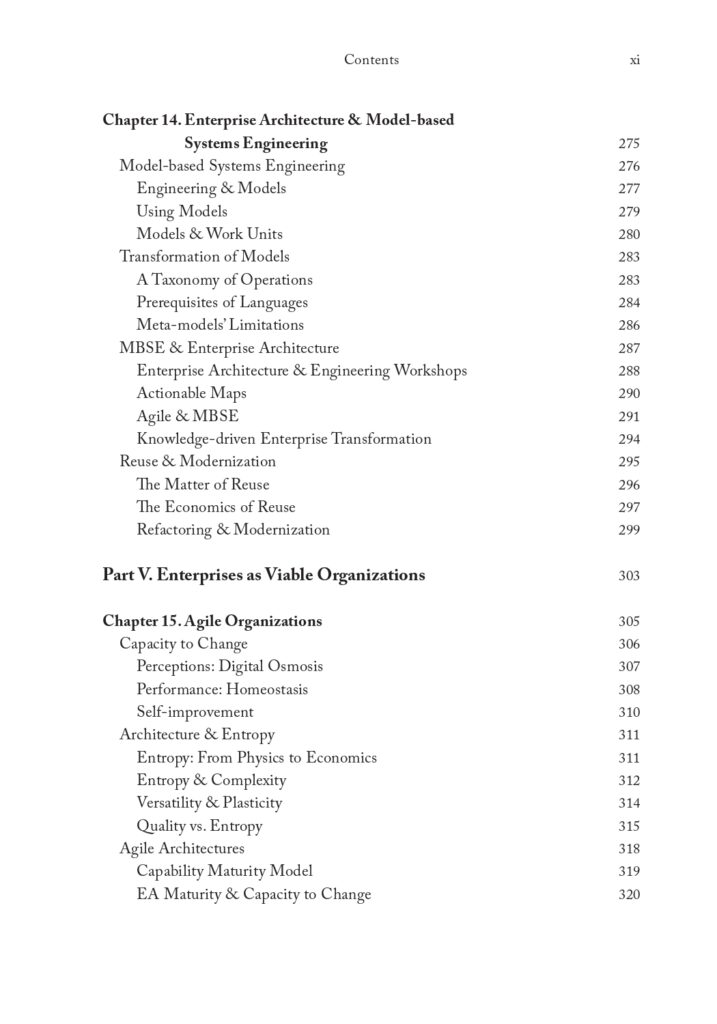
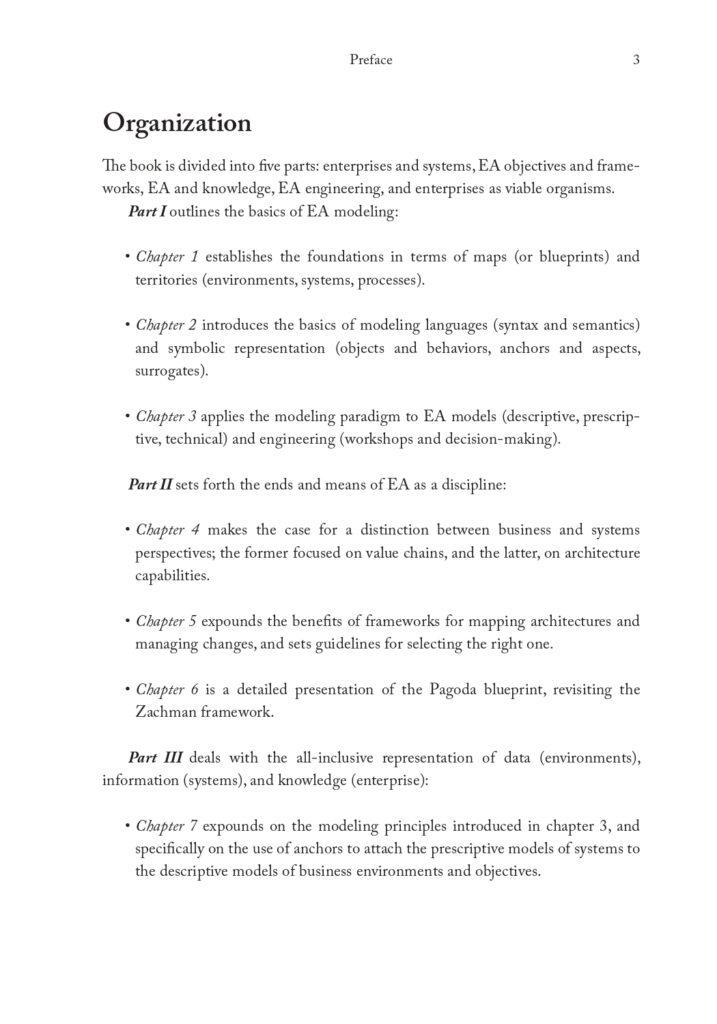
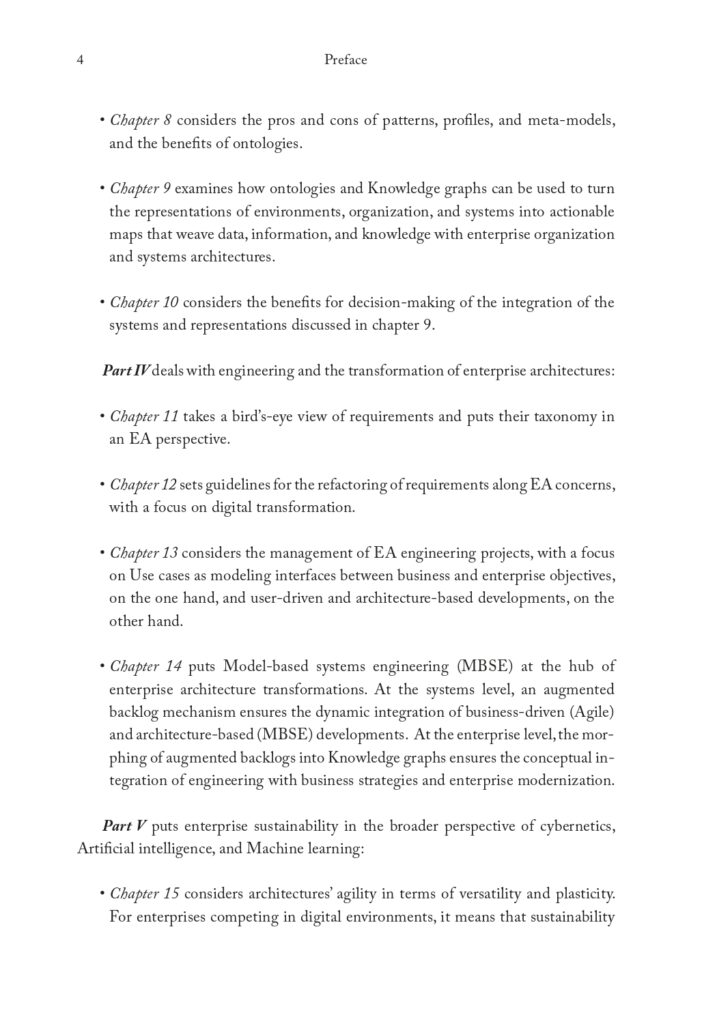
The book is divided into five parts: parts I and II take a general perspective on enterprise, systems, and frameworks, parts III and IV are focused on technical aspects, and part V takes a prospective view on new challenges and technologies.
For this book, we brought in a seasoned Big-5 nonfiction editor, managed the full production process, and ran a U.S. press run with a printer using only U.S.-sourced wood.
Weaving data, systems, and strategy into one actionable Pagoda Blueprint
Part one outlines the basics of enterprise architecture modeling:
Enterprises’ maps (or blueprints) and territories (environments, systems, processes)
Modeling primer: objects and surrogates
Modeling paradigm: environments and systems
Part two explains the core ideas of EA as a discipline:
Distinction between business and systems perspectives
Benefits of frameworks to map architectures and the management of changes
The Pagoda blueprint as a revised understanding of the Zachman framework
Part three considers the all-inclusive representation of data (environments), information (systems), and knowledge (enterprise):
Descriptive and prescriptive models
Profiles, meta-models, and the benefits of ontologies
Ontologies, Knowledge graphs, and the building of actionable maps of environments, organization, and systems.
Decision-making processes and the seamless integration of systems and representations.
Part four deals with engineering and the transformation of enterprise architectures:
Taxonomy of requirements and the distinction between architecture-oriented and business-driven requirements.
Refactoring of requirements along enterprise architecture concerns, with a focus on digital transformation.
Role of Use cases for the definition of business objectives, user-driven applications, and systems-oriented functions.
Role of Model-based systems engineering (MBSE) at the hub of enterprise architecture transformations, between Agile developments and systems modernization.
Part five considers enterprises as viable organisms and the consequences of new technologies for their resilience and evolution:
Enterprises’ capacity to change in terms of architecture versatility and plasticity, and the benefits of a revisited Capacity maturity model integration (CMMI)
Evolutionary impact of Artificial intelligence and Machine-learning technologies with regard to enterprises’ resilience in the face of disruptive changes in environments.
Category: Non-Fiction Release date: May 25, 2021 Page size: 7″ x 10″ Word count: 79,904 Estimated page count: 416
Book Interior
Rémy Fannader
About The Author
Rémy Fannader is an IT professional with an economics background. He has over 35 years of experience, mostly in consulting, in industries from banking and insurance to software engineering. Rémy has worked for a wide range of large firms; in particular, for two leading CASE providers, PAC Base (now with IBM) and IEF (then with Texas Instruments). He has published three books as well as more than two hundred in-depth articles about systems modeling, enterprise architecture, Artificial intelligence, and knowledge management through the Caminao website (4000 followers, 370000 visitors).
Want to See What Publishing Success Looks Like?
Still exploring? Great. Here are a few ways to get to know us better: