
For a serious author, the dedication page is not “extra.” It’s the first private sentence in a public book—and readers feel the difference between intentional and improvised.
Where the dedication page goes (and how it should look)
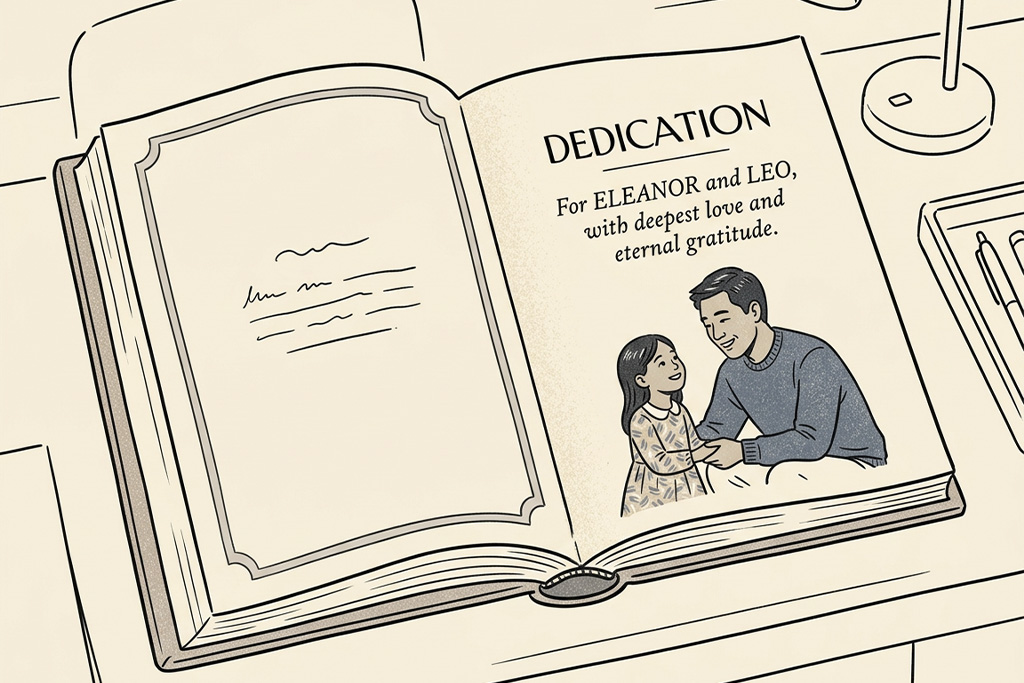
In most professionally produced books, the dedication sits in the front matter on its own page, after the copyright page. It’s usually centered, unnumbered, and placed early enough that it reads as part of the opening experience—not a footnote.
Three formatting norms to keep you out of trouble:
One page, one purpose: A dedication is not a preface. No backstory. No “why I wrote this book.”
Keep it short: One line is standard. One sentence is common. Two short sentences are typically the ceiling.
Design follows tone: A clean, centered line suits almost every genre. Decorative fonts or long paragraphs can look amateur fast.
A brief history: why dedications exist at all
Dedications weren’t always intimate. In early print culture, they often acted as public addresses to patrons or powerful supporters—part gratitude, part legitimacy signal. Over time, the modern dedication became more personal: a small threshold moment before the reader enters the story.
The Izzard Ink 5C framework for writing a dedication that feels professional
Most dedication pages fail for one reason: they try to carry too much meaning. Use the 5Cs to keep yours clean, true, and publish-ready.
Clarity: The reader should instantly understand who it’s for (or what kind of person/group), without decoding.
Concision: Short reads as confident. If you’re over two sentences, you’re likely writing acknowledgments.
Consistency: Match the emotional temperature of the book that follows.
Consent: If you name a real person, consider whether they’d be comfortable being named—especially in memoir or sensitive nonfiction.
Continuity: Write something you’ll still stand behind years from now (and across future books).
Decision rule: If you’re honoring one person (or a tight unit), it’s a dedication. If you’re thanking many contributors, it’s acknowledgments. If you’re setting theme or mood with a quote, it’s an epigraph.
What to write: 7 professional directions (choose one)
You don’t need a clever line. You need a line that fits your voice and leaves the reader oriented, not confused. Pick the direction that matches your intent:
Classic and direct: “For [Name].”
Role-based: “For my parents.” / “For my teachers.”
Value-based: “For those who taught me courage.”
Reader-facing (best for series/genre fiction): “For the readers who kept turning pages.”
Memorial: “In memory of [Name].”
Childlit-friendly: A playful dedication that matches the whimsy of the book.
Private but readable: An initial or nickname is fine if the line still makes sense to outsiders.
Two real examples from Izzard Ink–published books
Examples matter because they show restraint. Here are two different tones, both professionally executed.
Example 1 (personal, theme-aligned): In Mermaid Tears by Susan L. Read, the dedication begins:
“Dedicated to the memory of Steve M. Cohen, who taught me that ‘normal’ has no meaning.”
This works because it’s specific, emotionally aligned with the book’s subject matter, and immediately establishes stakes without explaining the whole backstory. (You can see how the project came together in the Mermaid Tears case study.)
Example 2 (playful, genre-fit): In The Tale of the Tooth Mouse by George H. Bentz, the dedication reads:
“Dedicated to all those wiggly, wobbly teeth out there!”
For children’s books, warmth and play are part of professionalism. The key is that it’s still short, on-tone, and instantly legible.
Common dedication mistakes (and quick fixes)
❌ Turning it into mini-acknowledgments: If you have a list, move it to acknowledgments and keep the dedication for one person/unit.
❌ Inside jokes that exclude the reader: If the reader can’t parse it, it creates distance on page one.
❌ Tonal whiplash: A joke before a grief memoir, or a solemn line before a light rom-com, can feel jarring. Match the opening promise of the book.
❌ Oversharing in memoir: A dedication can frame how readers interpret real people in the story. When in doubt, generalize (“for those who…”) or keep names private.
Note: This isn’t legal advice. If your book discusses real people in high-conflict or sensitive situations, consider getting professional legal guidance before naming anyone in the front matter.
Genre nuance for serious authors
Executive nonfiction: Understatement reads as authority. One clean line often wins.
Memoir: Choose safety and longevity. A dedication can intensify (or soften) how a reader enters the story.
Romance/series fiction: Reader-facing dedications can build loyalty—but keep them from sounding like marketing copy.
Literary fiction: Precision and restraint beat cleverness.
Children’s books: Let it be playful, but keep it short and clear.
A quick pre-publish checklist
✔️ Is it one person (or a tight unit), not a list?
✔️ Can a stranger read it without feeling excluded?
✔️ Does it match the book’s tone?
✔️ Will you still be proud of it in five years?
✔️ Is it formatted cleanly on its own page?
Frequently Asked Questions
How long should a dedication page be?
Most professional dedications are one line or one sentence. If you’re approaching a paragraph, you’re usually writing acknowledgments instead.
Can I dedicate a book to my readers?
Yes—especially in romance and series fiction. Keep it sincere, specific, and aligned with your author brand (avoid sounding like a sales pitch).
Can I dedicate my book to more than one person?
You can, but keep it tight: two names or a small unit is common. If you’re trying to include everyone, move those thanks to acknowledgments.
If you want your book to read “professionally” from the very first page
Small pages carry big signals. If you want expert clarity on what to refine—story, structure, and also the packaging details that shape reader trust—start with the Manuscript Assessment & Action Plan. From there, your next step might be professional book editing services, book cover design services, or a full publishing roadmap—based on what your manuscript actually needs.